June 5th, 2009 Software, Web | comments_icon19 Comments

Google Page Speed vs Yahoo YSlow

I try to stay away from cutting edge releases and let things cool off. But YSlow is one of my favorite web development toys tools and newly released Page Speed is perfect rival for it.

So two tools, two huge companies, both want to help us have better web pages. Who is better?

Disclaimer

I am no optimization guru. Just a techie who likes fast and responsive sites and wants his blog to be one. I guess exactly someone such convenient and simple to use tools are made for.

What they do

  • both YSlow and Page Speed are plugins for Firebug (which in turn is Firefox plugin);
  • both benchmark web page and analyze components to provide checklist of things that can be corrected and improved for better site load and rendering speeds;
  • both seem to be based on research of Steve Souders who created YSlow while he worked at Yahoo and now works on same things in Google.

Strong features

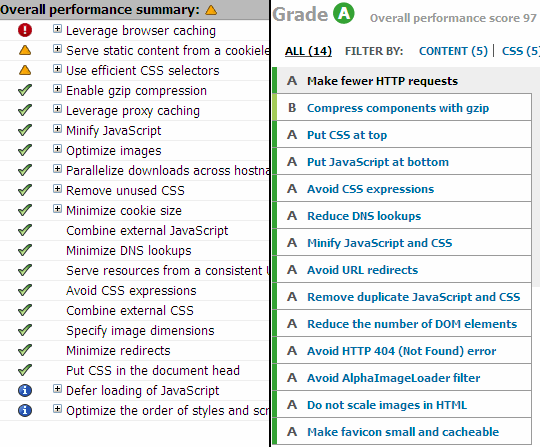
Since both tools use roughly same set of rules for their evaluations their core function is almost identical.
page_speed_vs_yslow

What differs are additional functions.

Page Speed

  • much more attention to CSS with extended advice on selectors – that is quite original (and, as some put it, questionable);
  • awesome Page Speed Activity function that is similar to page load timers but provides load graphs in real time.

YSlow

  • latest version got massive interface update with convenient visualizations and sorting capabilities, as well as option to print checklist;
  • different (editable) profiles to separate needs of high traffic sites from smaller ones;
  • boils results down to single grade that frankly tells you how much your site rocks (sucks).

Annoyances

While YSlow had remedied my last gripes (mostly habit of assuming my tiny blog could benefit from worldwide content delivery network) Page Speed brought fresh ones.

I had noticed that Page Speed offers minimized versions of scripts and images already from my hard drive (these have to be requested manually in YSlow). And bingo – Page Speed created two folders for its temporary files in my profile folder.

  • not Firefox extensions folder;
  • not temporary folder;
  • not local settings;
  • not application data.

Which would all seem like sane choice unlike profile root. At least it had courtesy to delete files (not folders) on closing Firefox.

Update Page Speed now uses sane temporary folders for those files on all platforms. :) Excused on this one.

Frankly large reason I try to stay away from desktop software by Google is their sickening habit to treat my PC as their own, filling it with files and background services as they see fit. Is there no one working for them who has clue about portable?

Overall

While Page Speed brings some new powerful functions to the table, overall first release feels like what it is – internal tool released to the public.

YSlow has edge – around for longer, more developed and more convenient.

In the long run if Page Speed can throw YSlow from the throne will depend on amount of effort and open source contributions it gets.

Google Page Speed http://code.google.com/speed/page-speed/

Yahoo YSlow http://developer.yahoo.com/yslow/

RSSGet updates via RSS

19 Responses to “Google Page Speed vs Yahoo YSlow”

  1. Phil says:

    Couldn’t agree more, it’d be nice if Page Speed gave you some sort of overall grade that you could use to assess your pages overall performance.

    I’m also not sure about this whole “lets develop the app in the quiet and suddenly make it go open source for a big impact” attitude that Google seems to adopt.

  2. Rarst says:

    @Phil

    I guess Google tries to keep its image high. It’s probably easier to predict how will product fare in real conditions if you have years of internal usage data first.

    If Google lets too many projects fail their reputation would be notches lower than it is.

  3. We chose to use the home directory so people could navigate easily to pick up optimized images or minified JavaScript and the like; some of our users really liked that. obviously, many don’t and we filed a tracking bug and are working on fixing it to default to a tmp directory

  4. Rarst says:

    @Richard Rabbat

    Well, Page Speed generates direct link to file from its interface so physical location is hardly an issue for that.

    In some scenarios (using with portable Firefox for example) non-standard directory is much more of privacy/security issue than using temporary one.

    Thanks for dropping by and good luck with development! Can’t say YSlow got lazy (on the contrary it is quite active lately) but some competition never hurts. :)

  5. we released an updated version of Page Speed that uses temp directories and doesn’t touch home directories. I hope this helps

  6. Rarst says:

    @Richard Rabbat

    Thank you! I had updated post accordingly. :)

    Since YSlow is lagging behind in Firefox 3.5 compatibility I am going to see much more of Page Speed in some time. Keep up nice pace and good luck in development.

  7. [...] Google Page Speed vs Yahoo YSlow (859) [...]

  8. [...] and is used in conjunction with Firebug. Want to know how YSlow compares to Page Speed? Check out Rarst.net who already did the job for us back in June. Consensus seems to be that YSlow is the more developed [...]

  9. [...] Google now offers there own performance analysis tool: Google Page Speed. Like YSlow, it tags on to the Firebug backend. Initial reports are mixed, but there’s a helpful comparison of both tools here. [...]

  10. Very helpful comparison of YSlow and Page Speed. Of course Google’s Page Speed is a useful new tool for optimisation of your website. However, it’s quantity over quality, top priority is given to speed (then again maybe it’s just what you need): for example, CSS selector doesn’t allow you to build object-oriented CSS. So firstly you must set your goals and only then choose YSlow or Page Speed for yourself. So in my opinion Yslow is the more reliable and convinient tool, I agree with the author.
    By the way Chrome and Safari have a similar tool – The WebKit Inspector. I’m looking forward when Opera will get something like this too.

  11. Rarst says:

    Actually Opera has development tools called Dragonfly for some time already. They are working slowly on it (it is alpha-something at moment) but it is already quite useful.

  12. Hadith says:

    Thanks for the enlightenment, Im using pagespeed now but I guess I have to try yslow now.

  13. Rarst says:

    @Hadith

    You are welcome. :) Actually either of tools does fine job, I mostly use both and hadn’t decided to drop one yet.

  14. [...] and is used in conjunction with Firebug. Want to know how YSlow compares to Page Speed? Check out Rarst.net who already did the job for us back in June. Consensus seems to be that YSlow is the more developed [...]

  15. [...] why I had been slacking this week. Now with that out of the picture on to post! :)YSlow and Page Speed are essential tools for optimizing site performance. However there is considerable installation [...]

  16. Both tools have their pros/cons. I really like their beaconing facility, so I can save historic data and generate reports from them. From this I went and created a free online portal http://pageshow.jaoudestudios.com where users can beacon their results privately to their account from yslow & page speed (hopefully also httpfox when they add beacon facility – httpwatch equivalent), these results are also validated against w3c.

    More reports coming soon, any suggestions are welcome.

  17. Rarst says:

    @Eddie Jaoude

    Interesting feature with beacons, never tried that. :) I had bookmarked your page to check out.

Leave a Reply